
Love remains the primary tool that prevents the penitentiary system from completely destroying a woman’s individuality in detention. It is the profound understanding that people are waiting for you on the outside, fighting for you, and proud of you. The story of Palina Sharenda-Panasiuk and her husband Andrei is an example of how facing trials together is capable not just of preserving a family, but of making it stronger.
Andrei: Both Father and Mother
While political prisoner Palina was serving her four-year sentence in the colony, her husband Andrei held the family together on the outside. For him, this was a time of serious transformation and taking on colossal responsibility. Andrei virtually became both father and mother to their children at the same time.
It was a difficult, grueling path that required a complete restructuring of their usual daily routine and lifestyle. Andrei learned to cook, took on all the household chores, and achieved true independence and fortitude to provide for and protect the children on his own while his wife was behind bars. At the same time, he did not stop fighting for Palina’s release for even a single minute.
“We Both Fought for Each Other”
For Palina herself, knowing what was happening on the outside and feeling her husband’s support was a vital anchor. She emphasizes that their trial was not one-sided—it was a joint battle in which each held their own front.
“I will say that we both fought for each other,” recalls Palina Sharenda-Panasiuk. “I fought for him in those places, too… He changed for the better as a man… He learned to cook… He achieved the independence required of a real man to support the children, the family, and to fight for his wife…”
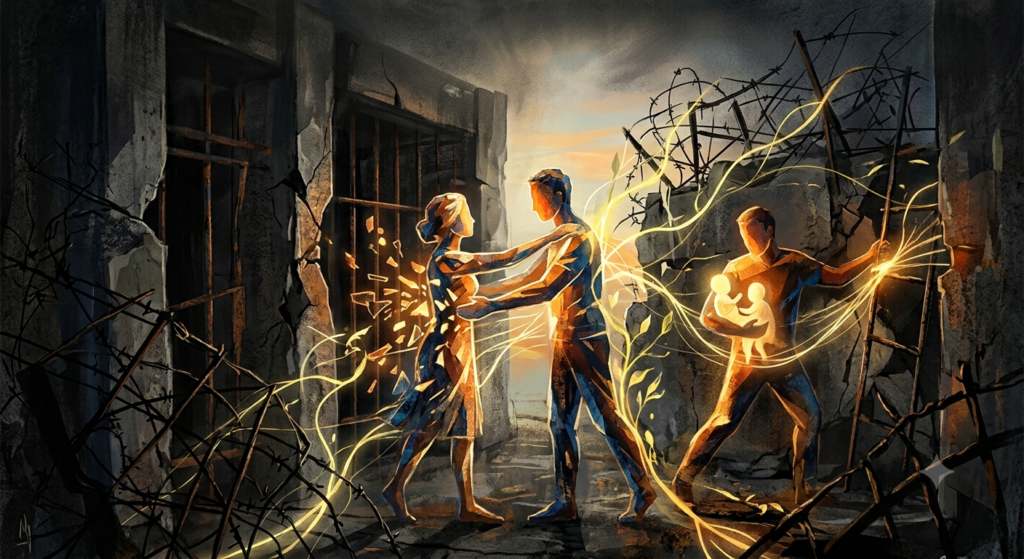
This long-awaited journey concluded with the moment they had replayed in their minds thousands of times—their first embraces on the outside after years of separation. It was a moment of quiet but incredibly powerful realization of their victory:
“We just looked at each other. Then we embraced, of course, and said: ‘Well, did we endure it all? We made it through, we are together again.'”
“We Are Optimistic”
Returning to a life together requires strength, but Palina and Andrei fundamentally reject the role of martyrs. The imprisonment and the colony are in the past, and the family consciously refuses to let the darkness they endured poison their present day.
“You know, we are optimistic right now,” Palina shares. “We look to the future. And we don’t talk about prison. When we do speak of it, it’s more in a humorous way. We made it through. We endured it. We are not victims, we are heroes. We are moving forward.”
Accepting the experience of imprisonment without adopting a victim mentality—viewing themselves as heroes instead—is a crucial psychological step on the path to successful resocialization. The penitentiary system is capable of stealing years of physical freedom, but it is powerless against shared optimism, loyalty, and love. When people fight for each other, they don’t just survive trials; they build a solid emotional foundation for returning to a normal life. It is precisely this mutual recognition and the ability to look into the future together that allow a person to quickly and painlessly restore their social roles, preserving their own dignity and humanity.