




Our human rights information materials are, as a rule, not only saturated with factual data but also vividly charged with emotion. This is true, and it is entirely justified.
However, today we would like to speak the language of numbers regarding the issues of resocializing former prisoners. Despite the common phrase “the dry language of numbers,” our data today will be quite eloquent.
It must be clearly understood that activities aimed at the resocialization of former prisoners require significant resources, which the NGOs of any country typically do not possess. This is where the state must step in to help. The question inevitably arises: is such an investment of budget (read: taxpayers’) funds effective?
In the article “The Next Step: How Can We Help?”, we wrote about a sociological study on the needs of prisoners and former prisoners during their reintegration into society after release. But there was another highly interesting study on the economic efficiency of resocialization activities, organized as a pilot project by an interfaith religious organization.
Christian churches of various denominations in Belarus have a certain amount of experience in targeted resocialization work specifically with the category of former prisoners. It is crucial that some of these centers, alongside traditional spiritual support, are able to provide unique services such as accommodation, employment directly within the churches, or assistance in finding jobs in other organizations, as well as several other services tailored to individual needs.
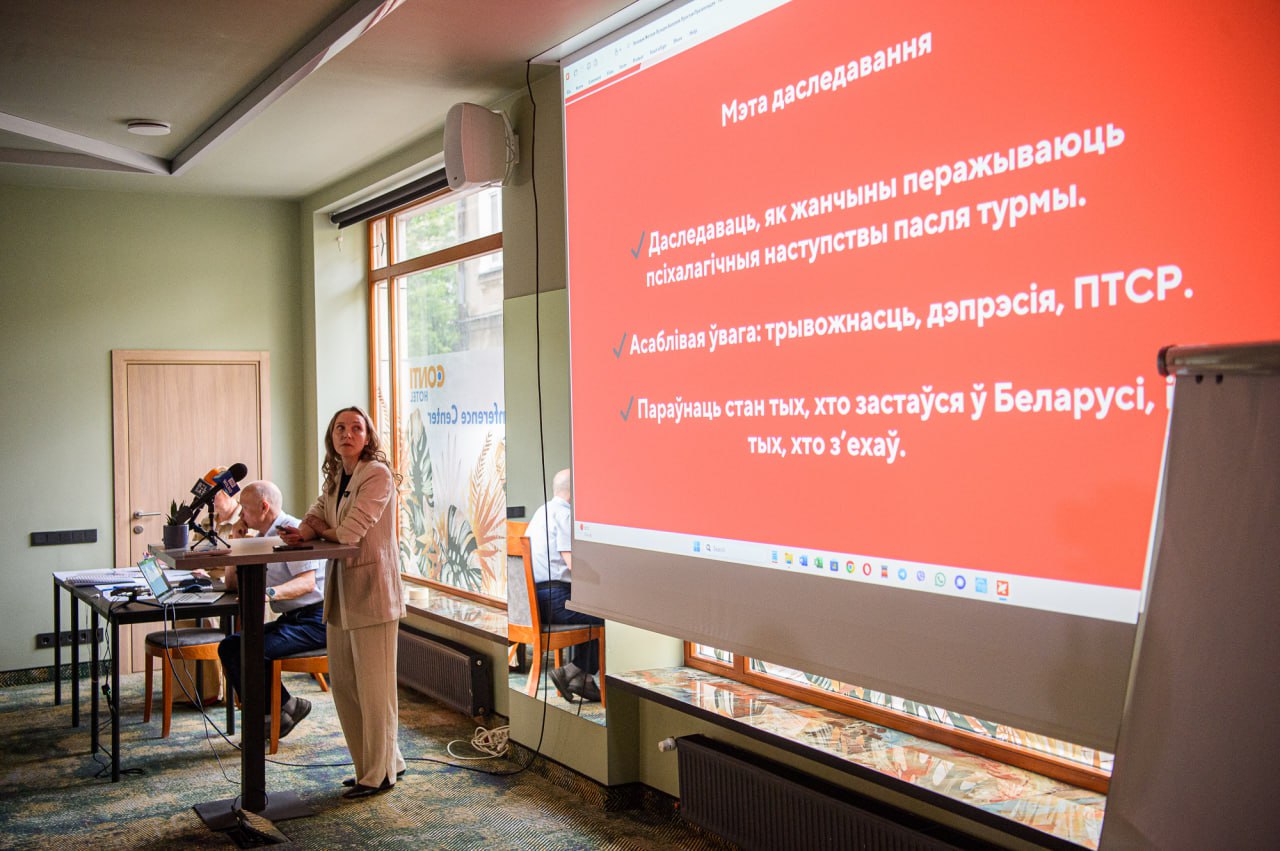
In 2017–2018, the Center for Social and Economic Research (CASE) conducted a study on the socio-economic efficiency of a resocialization program for former prisoners, using the example of an Orthodox parish in the village of Chonki, Gomel District, and achieved very interesting and encouraging results. Here are some of the conclusions of this study.
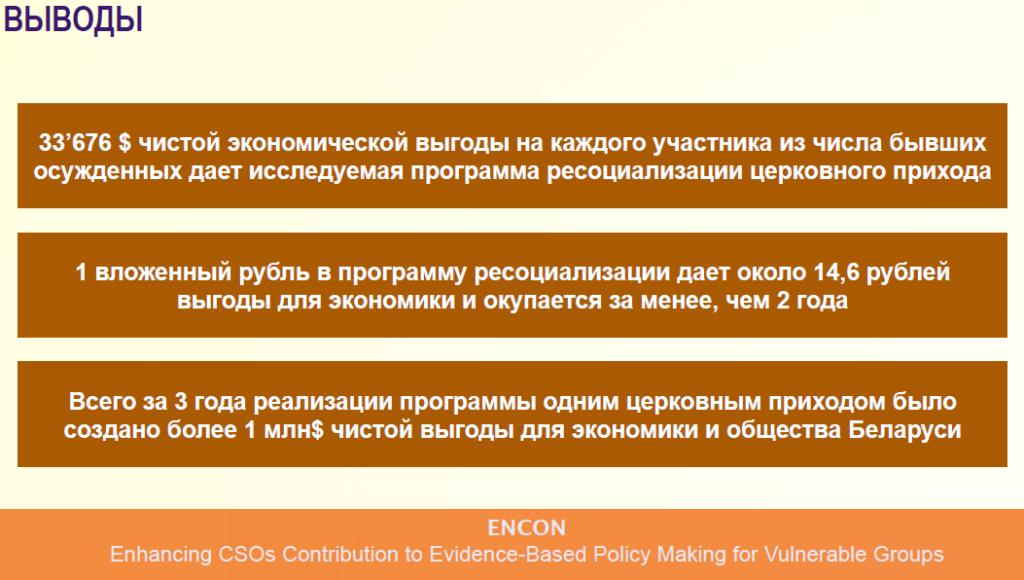
As we can see, this study showed that under proper, comprehensive organization, 1 ruble invested in resocialization yields more than 14 rubles in benefits! For us, it is also significant that this specific location was used for the resocialization of women released from Belarusian female penal colonies.
Granted, it would be incorrect to mechanically extrapolate this single researched example to other resocialization platforms, especially non-church ones. One might question whether the economic efficiency of resocialization work is as high in other organizations; however, there is no doubt that it Ultimately brings a proven economic benefit to society and the state, not to mention the other components of its “utility.” At the same time, it is important to emphasize that despite the economic independence of the churches, the project studied by CASE was carried out with external financial support—in this case, from the European Union. This means that executing a full spectrum of a resocialization program using only one’s own resources is very difficult, if not impossible, even for churches. Yet, in the Belarusian reality, churches are very reluctant to request material support from state structures, fearing complex bureaucratic procedures for the allocation of funds and subsequent control over their use, as well as over the activities of the religious organizations themselves should they receive such aid. As one priest put a it: “A ruble’s worth of help, but a hundred rubles’ worth of control, accountability, and reporting!”
Be that as it may, this example eloquently demonstrates the undeniable economic benefit of resocializing former prisoners for both the state and society as a whole. The main thing is for the state to turn its attention to human needs, not just in words, but in deeds.
That is what we are working for.