

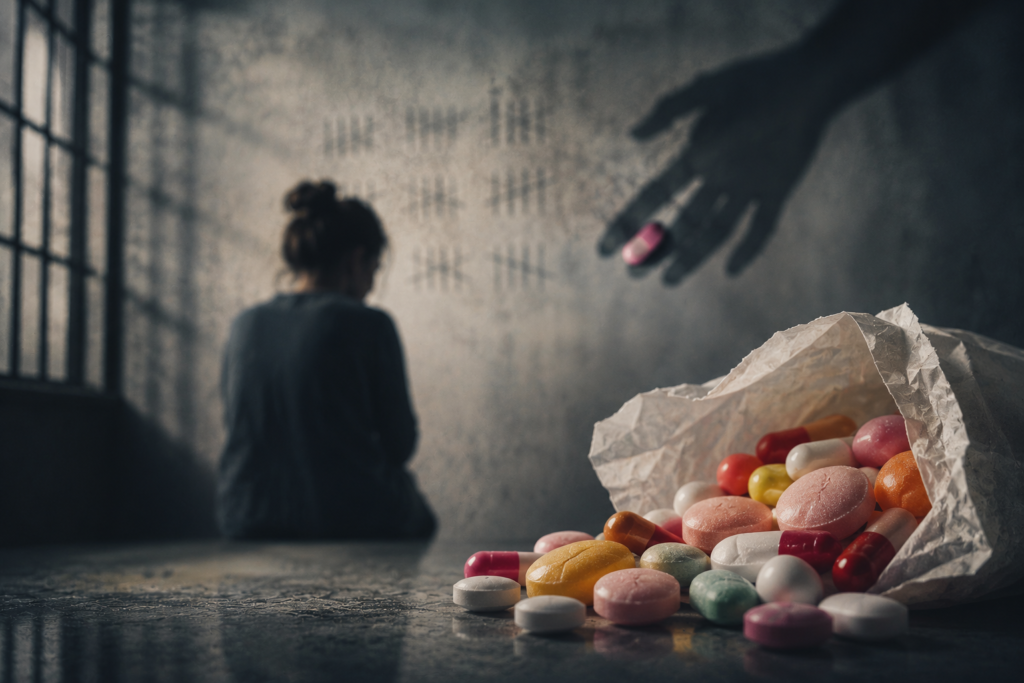
Today, within the context of resocialization, we examine one of the most closed topics of the contemporary Belarusian penitentiary system: the use of medication as a tool of violence and control. Where a person, faced with colossal stress and isolation, requires nuanced psychological support, the domestic punishment machine offers methods that former prisoner Palina Sharenda-Panasiuk calls punitive psychiatry.
Carbamazepine Instead of Compassion
“From the very beginning, I always categorically stated that I would not take any medication. ‘I refuse to take any medicine whatsoever from you,'” recalls former political prisoner Palina Sharenda-Panasiuk, speaking of her experience in female penal colony No. 24 (located in the settlement of Zarechcha).
According to her, prison medicine is aimed not at curing a person or helping them cope with psychological stress, but at making them submissive and defenseless. Heavy psychotropic drugs, used by the administration and medical staff without actual medical indications, become the primary tool for this.
“First of all, I am a mentally healthy person, a political prisoner. Your psychiatry is punitive. It is clear that with your pills, you might not cure someone, but simply drive them mad. And this was visible in this colony No. 24, where they handed out Carbamazepine to people like candy,” says Palina Sharenda-Panasiuk.
Carbamazepine is an anticonvulsant and mood stabilizer which, when improperly or deliberately prescribed in high doses, can suppress the central nervous system, causing apathy, lethargy, and a complete loss of willpower. Handing out such medication “like candy” turns prisoners into powerless executors of someone else’s will, capable only of silently enduring psychological pressure from the administration.
Medical Blockade
At the same time, the opportunity to protect one’s health with safe, proven remedies is methodically restricted in the colony. Detention rules are constantly changing to become harsher. As Palina Sharenda-Panasiuk emphasizes, while imprisoned women used to be able to at least receive necessary vitamins or medicines from their relatives and keep them with them or in the medical unit, this channel was later completely cut off.
To obtain even the simplest medication, confirmation from a prison doctor is required. Given the general atmosphere of female colonies, where the management can openly display signs of misogyny and act like “smiling scoundrels” (as Palina described the colony warden), securing an adequate prescription becomes impossible. Any attempt to seek medical treatment turns into a journey through bureaucratic hell and humiliation.
Irreversible Changes to the Psyche
The consequences of isolation, psychological violence, and inadequate medical care leave a deep and often incurable mark. Prison deprives a person of a basic right: to control their life and plan for the future. When this drags on for years, the body and the psyche begin to break down.
Human rights defender and physician Vasil Zavadski points to scientific research confirming the catastrophic impact of prolonged imprisonment on a human being: “Among other things, there are studies by scientists stating that, if I am not mistaken, after five years of imprisonment, distinct changes occur in a person’s psyche and psychology that persist for the rest of their life.”
This experience of deprivation of liberty can hardly be called positive. Even years after their release, people cannot hold back tears when recalling what they endured behind bars. The trauma sustained in the colony (against the background of less-than-qualified psychiatric care) requires prolonged and very delicate rehabilitation. Yet, once the colony gates are behind her, the former prisoner faces not the assistance of specialized psychologists, but a new cycle of state control, supervision, and coercion.
Today, female penal colonies in Belarus are not about rehabilitation and resocialization, but rather about total control and a destructive impact on the individual, aimed at erasing individuality and degrading human dignity. It is particularly disheartening that this occurs with the complicity or, at the very least, the passivity of psychological and medical services—institutions that were created by humans for entirely opposite purposes.